Steven Brown           Blackburn School of Art

Module - IA20701. Fine Art .

SEEING - THINKING - DOING

Are immersive installations changing how we look at art?

What is Immersive Art?

INTRODUCTION


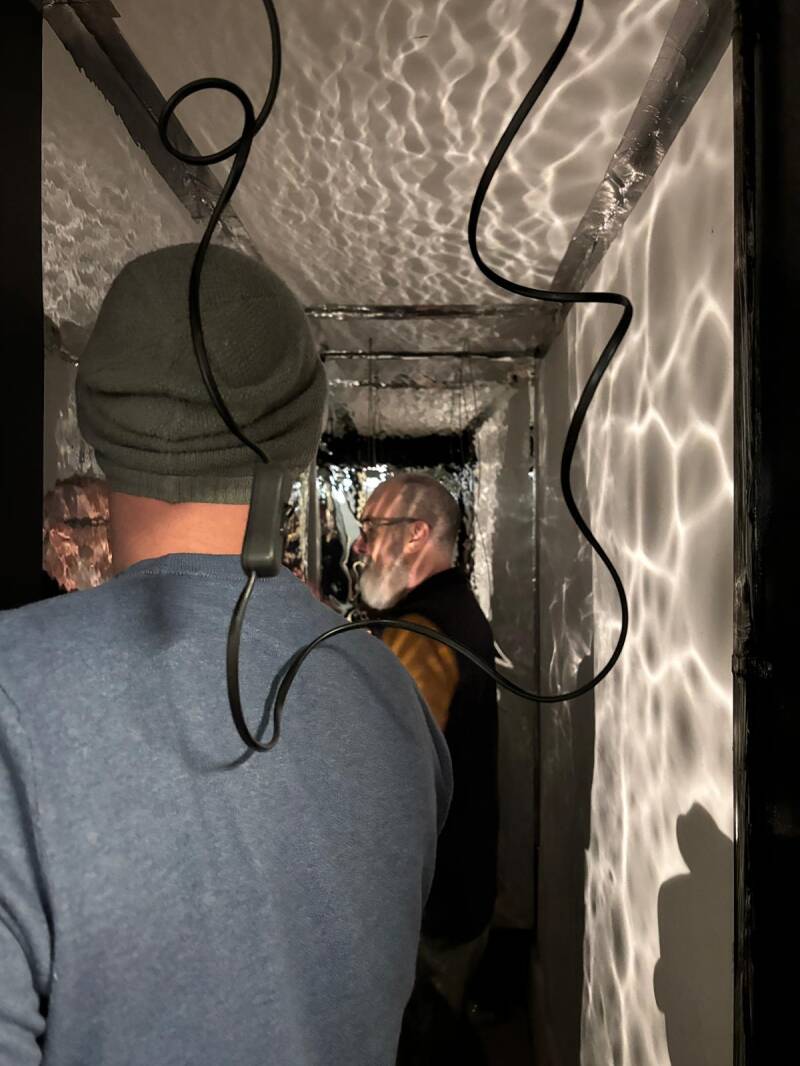
The term “Immersive Art” can be interpreted in different ways across different sectors. For some it can be seen as art that uses technology to actively involve an audience (Clarke 2025). In broader terms immersive art involves sensory engagement and some active participation beyond the use of technology. Interaction may involve the viewer walking through and around a piece, looking, touching, reacting to the work as the experience evokes an emotional response.
The idea of Immersive Art is not a new phenomenon. An exhibition in 2023, organised by the Musée cantonal des Beaux-Arts (2023), claimed to be the first to trace the emergence of immersive art, identifying between the years 1949 and 1969 as a key period for the urge to go beyond traditional categories of art and to explore innovative uses of the gallery space and, whilst the 1950s and 60s can be seen as a period of exploration and new ideas, embracing changing attitudes and technology, the desire to encompass the viewer in a sensory experience has existed throughout art history. Grau (2004), in discussing an overview of the historical antecedents in art to virtual reality, shows how each epoch used the technical means available to produce maximum illusion, giving examples from antiquity and the church, developments through the Renaissance to nineteenth century panoramas, each era developing its own form of illusion.


As the increasing possibilities of sensory technology has grown so has its potential for use in the world of Art. The gap between traditional exhibitions and immersive, interactive displays, whilst remaining, is becoming smaller, with curators embracing new ways of presenting art and exploring how the visitor experience can be enhanced, encompassing the aesthetic and educational dimensions alongside the values of entertainment. Popoli and Derda (2021) described a flow chart of actions to consider when planning an exhibition, giving some structure and analysis to the process, which may give a suitable framework for curators to explore alternative ways of planning and displaying an exhibition.


The immersive art experience is presented in many new forms, often away from the traditional gallery, targeting different audiences, emphasising the sensory impact for the individual and the corporate value to the commissioners and organisers, such as town councils or entertainment hubs. Examples can be seen in the growth of Light Festivals (Light up the North, 2021) that offer large scale public displays of interactive sculptures and light shows, and agencies such as Frameless (Frameless, n.d.) who market experiential, immersive art experiences based upon the work of well-known and popular artists. A further extension can be seen with teamLab, (teamlab, 2019) an international collection of artists and technicians presenting new art exploring how to blur the boundaries between the artwork and the audience by using sophisticated, interactive projections.


Immersive art experiences generally create a space that surrounds the viewer, whether that is for passive or active involvement (Rodriguez et al. 2024), aiming to evoke an emotional response. The rise of themed experiences, with overviews of an artist’s work offer a new interface between the viewer and the art, sometimes at the risk of creating a populist spectacle. All of this can be seen to influence the type of art presented, perhaps with an eye to popularism and profit being the driving force.


How society is SEEING, THINKING about and DOING Art can be described further:


Architecture and internal decoration has long been used to create atmosphere and induce awe in those who visit.

MURALS , POMPEII

Westminster Abbey

Entrance Hall, Tate Britain

Seeing

Looking, Observing, and SEEING in art can be described in differing ways. Vinther (2023) describes her approach and suggests a how-to, to see better. When we look we capture an image, a sensation that can form an impression in the mind. SEEING is an active process that asks you to challenge perception.

On a broader level, how we look at art can reveal much about the social and political systems of the era it was made (Berger, 1972). There is a cultural and historical context to how we perceive the things we are SEEING. We need to be encouraged to be critical of what we see, to understand the ideologies and dynamics of art, and to examine our own assumptions.

Thinking

Art THINKING (Whitaker, 2016) can guide (business) systems to greater creativity, using a mind-set that allows exploration of new ideas. The ways that artists think when examining the world around them can be innovative and bring new things into our cultural experience.

Artists submit ideas to a process of research, reflection and exploration (Sandburg, 2021), often thinking in mediums - be it an object, a sound, or a movement - and are willing to experience the unknown. A multiple of perspectives and a willingness to improvise can lead to thinking that challenges the status quo.


Doing

For any artist it is important to  be DOING art and this act is an evolving and maturing thing.

Artistic creation is a problem solving process in which exploration is an essential act. (Sawako and Takeshi. 2021). Emerging and young artists have a tendency to work unsystematically, modifying their approaches in random ways, making drastic changes to the subject, method and concept of the artwork they produce.

Expertise is developed over many years as artists find patterns of concept formation and apply analogical modification to new projects. New work becomes related to old, and an artist forms a network of ideas, a creative vision.

For galleries and Immersive Art agencies the focus is on the viewer's experience. In many settings, including many gallery institutions, the ideas of SEEING, THINKING, DOING, are repackaged as an educational tool, with the headings SEE, THINK, WONDER, aiming to encourage deep observation, interpretation, and questioning, moving beyond mere description to foster critical thinking and emotional connections. Setianingsih (2025) describes a critical thinking process that helps students consider their observations to generate more meaningful insights and interpretations. This may go some way to convincing institutions that they continue to provide an enriching environment, but this is set against the challenge of competing with commercial Art Experiences whose only aim is to provide entertainment that people will pay for.


Email

Socials